Autonomous Operation
Source: nct_v2/v11_autonomous.py Lines: 1,830 Classes: 11
Neuroscience Foundation
The brain has no “training mode” vs “inference mode.” Every perception updates synapses. Every sleep consolidates memory. Every moment of boredom triggers curiosity. This module closes the autonomy loop, making NCT a living, self-improving system with eight autonomous subsystems.
Always-On Learning (AlwaysOnLearning)
After every forward pass, whether training, inference, or generation, local learning updates run. The effective learning rate is dynamically modulated:
High acetylcholine (attending) more learning. High norepinephrine (aroused) more learning. High surprise more learning. High sleep pressure (tired) less wake learning.
Imagination Engine (ImaginationEngine)
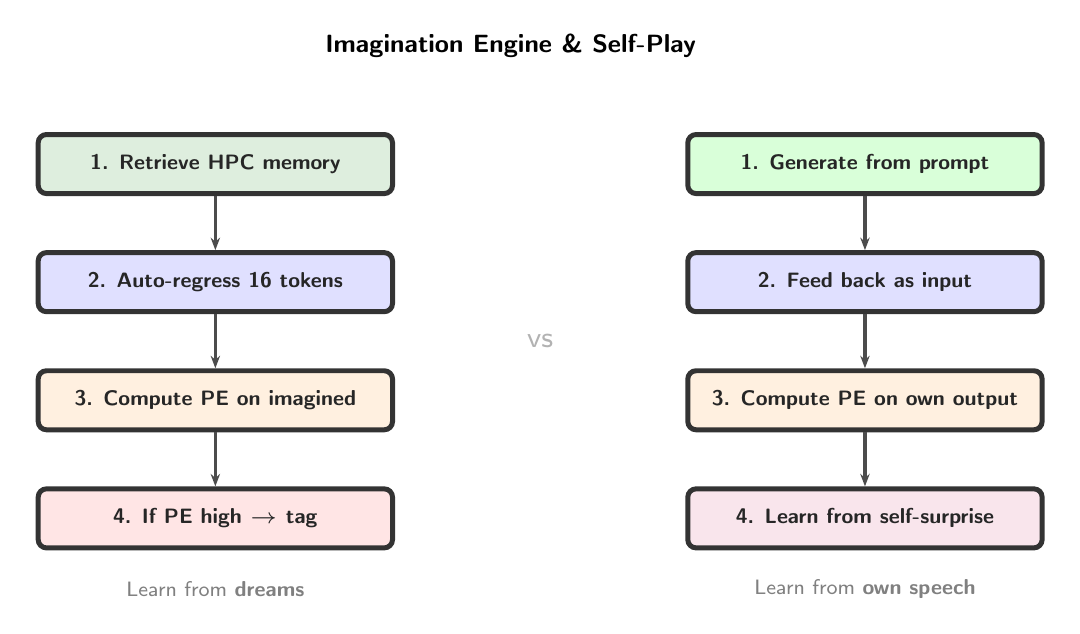
Theorem 27 (Learning from Imagination). The brain learns not just from reality but from imagination. The engine:
Retrieves a hippocampal memory as seed
Auto-regressively generates a continuation (up to 16 tokens)
Evaluates the imagined sequence (computes prediction error)
If PE is high (novel imagination), tags for additional replay
This enables “dreaming”, learning from imagined scenarios, not just replayed experiences. The distinction from standard replay: imagination generates novel sequences not seen in training data.
Curiosity Drive (CuriosityDrive)
Theorem 28 (Expected Free Energy Minimization (Friston, 2010)). Inputs that would maximally reduce prediction uncertainty are prioritized: In practice, the curiosity score is computed as the variance of across columns: inputs where columns disagree on their certainty are scored highest. The system can also generate “curious prompts” by sampling from high-uncertainty vocabulary items.
Self-Play (SelfPlay)
The brain processes its own speech (auditory cortex hears you speak), creating a generate perceive evaluate learn feedback loop. NCT implements this as self-play:
Self-play loss measures how surprised the model is by its own output. High self-play loss = the model surprised itself = learning opportunity. Self-play activates every 10 steps after a 200-step warm-up. If last 3 self-play losses all exceed 15.0 (still producing gibberish), interval increases .
Disease mapping: inner speech deficits (schizophrenia) inability to monitor own speech thought insertion. Stuttering failed forward model of own speech production.
Continual Learning Guard (ContinualLearningGuard)
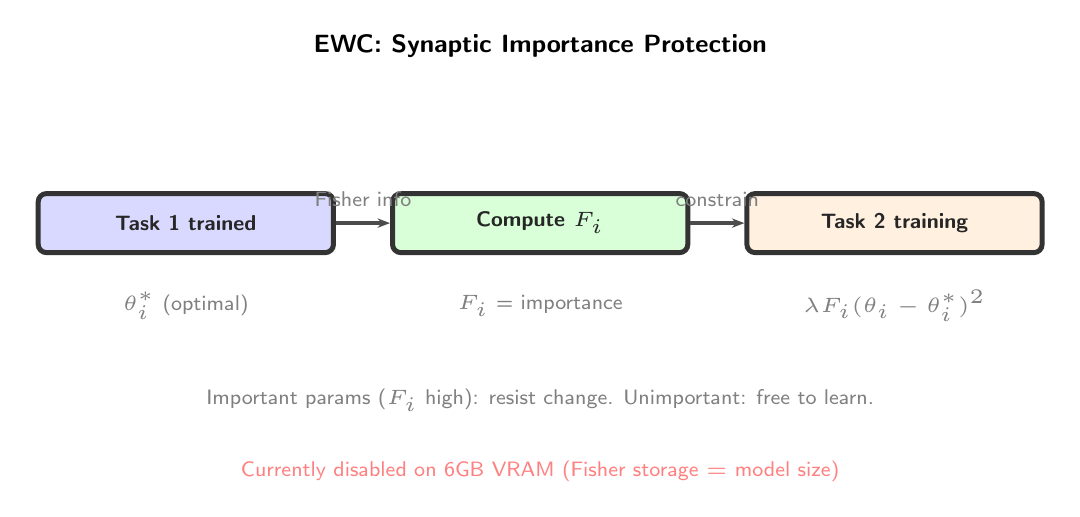
EWC-like (Kirkpatrick et al., 2017) synaptic importance estimation:
where is the Fisher information (importance) of parameter and is the optimal value from previous tasks. Parameters that were important for old tasks resist modification. Currently disabled on 6GB VRAM due to memory constraints (Fisher estimation requires storing per-parameter importance scores).
Consolidation Manager (ConsolidationManager)
The complementary learning systems theory (McClelland et al., 1995) posits that the brain uses two systems with different learning rates: the hippocampus learns quickly (one-shot episodic encoding) while the neocortex learns slowly (gradual statistical extraction). During sleep, the hippocampus “teaches” the neocortex by replaying stored episodes, gradually transferring knowledge from fast episodic storage to slow semantic storage.
The ConsolidationManager implements this transfer pipeline. It tracks how many times each hippocampal memory has been replayed during sleep phases. When a memory has been replayed at least times (indicating it is a recurring, important pattern rather than a one-time anomaly), it is promoted: the cortical column weights are updated to represent this pattern natively (without hippocampal support), and the memory is removed from the HPC buffer to free capacity for new episodes. This produces the biological phenomenon of systems consolidation: recently learned facts depend on the hippocampus, but well-consolidated knowledge becomes hippocampus-independent.
Autonomous Loop (AutonomousLoop)
The main orchestrator managing the complete autonomous cycle without human intervention. On each step:
Wake: Process input always-on learning tag surprises accumulate sleep pressure.
Periodic: Self-play (every 10 steps), curiosity-driven batch selection, health monitoring.
Sleep (when pressure exceeds threshold): Replay downscale imagination consolidation reset pressure.
Evaluate (periodic): Run validation, check for divergence, update self-assessment metrics.
The loop can run indefinitely in continuous mode, a never-ending self-improving cycle.
Prenatal Development (PrenatalDevelopment)
Theorem 29 (Prenatal Self-Organization). Before any external data, the network bootstraps through spontaneous activity, mirroring prenatal brain development:
1. Spontaneous Waves (30%): Momentum random walk in embedding space (Meister et al., 1991). Velocity . Teaches L2/3 about local temporal structure: “nearby things are related.”
2. Motor Babbling (25%): Auto-regressive self-generation (Doya & Sejnowski, 1998). The model generates from its own predictions (capped at 16 tokens), creating a production-perception loop. Calibrates the generate predict cycle.
3. Competitive Differentiation (25%): Structured patterns (repeated motifs, gradients, alternating sequences) force columns to specialize through competitive Hebbian learning. Each pattern type drives different statistical selectivity.
4. Oscillatory Calibration (20%): Multi-frequency sinusoidal input (Khazipov & Luhmann, 2006). Calibrates oscillatory periods () and coupling strengths ().
After prenatal development, the network is not a blank slate, it has calibrated rhythms, differentiated columns, and functional prediction circuitry.
Source Code
# Apply any kwargs overrides
for k, v in kwargs.items():
if hasattr(cfg, k):
setattr(cfg, k, v)
model = CorticalColumnNetwork(cfg)
return model
# ===========================================================================
# Autonomous Operation (Wake-Sleep, Prenatal, Imagination)
# Source: nct_v2/v11_autonomous.py
# ===========================================================================
"""
NCT V11: Autonomous Operation — The Life of a Brain
=====================================================
The brain has no "training mode" vs "inference mode." It's ALWAYS learning.
Every perception updates synapses. Every sleep consolidates memory.
Every moment of boredom triggers curiosity.
This module closes the autonomy loop, making V11 a living, self-improving system:
1. AlwaysOnLearning: Learn from every token processed (no train/eval distinction)
2. ImaginationEngine: Generate synthetic experiences from memory, learn from dreams
3. CuriosityDrive: Expected free energy → seek maximally informative inputs (Friston 2010)
4. ConsolidationManager: Episodic → semantic transfer (McClelland et al. 1995)
5. ContinualLearningGuard: Protect old knowledge while learning new (synaptic importance)
6. AutonomousLoop: Orchestrates wake/sleep/dream/evaluate without human intervention
Disease mapping:
- Alzheimer's → consolidation failure → forgetting
- ADHD → curiosity dysregulation → can't focus
- Insomnia → no sleep consolidation → degraded learning
- Anosognosia → no self-evaluation → unaware of deficits
- Depression → no curiosity drive → learned helplessness
"""
# ═══════════════════════════════════════════════════════════════════════
# 1. Always-On Learning
# ═══════════════════════════════════════════════════════════════════════
class AlwaysOnLearning:
"""
The brain learns from EVERY experience. There is no eval() mode in biology.
After every forward pass — whether training, inference, or generation —
local learning updates run. PC adjusts predictions, Hebbian adjusts
associations, neuromod gates everything.
The learning rate is modulated by:
- Acetylcholine (high attention → more learning)
- Norepinephrine (high arousal → more learning)
- Surprise (high PE → more learning)
- Sleep pressure (close to sleep → less wake learning)
This is the difference between a brain on a slab and a living brain.
"""
def __init__(self, base_lr: float = 1e-4, sleep_pressure_decay: float = 0.999):
self.base_lr = base_lr
self.sleep_pressure = 0.0 # 0 = just woke up, 1 = need sleep
self.sleep_pressure_decay = sleep_pressure_decay
self.total_experiences = 0
self._ewc_guard = None # Set by AutonomousLoop when EWC is initialized
def compute_lr(self, neuromod_state) -> float:
"""Compute effective learning rate from neuromodulatory state."""
# ACh gates plasticity (attention → learning)
ach = neuromod_state.acetylcholine.mean().item() if hasattr(neuromod_state, 'acetylcholine') else 0.5
# NE gates arousal (surprise → learning)
ne = neuromod_state.norepinephrine.mean().item() if hasattr(neuromod_state, 'norepinephrine') else 0.5
# Sleep pressure reduces learning efficiency
wake_efficiency = max(0.1, 1.0 - self.sleep_pressure)
return self.base_lr * (0.5 + ach) * (0.5 + ne) * wake_efficiency
def on_experience(self, model, result: dict):
"""
Called after EVERY forward pass. Runs local learning.
Sleep pressure accumulates proportional to prediction error —
high surprise experiences are more "tiring" (adenosine analogy).
"""
self.total_experiences += 1
# Base pressure accumulation (1 - decay ≈ 0.001 per step)
base_increment = 1.0 - self.sleep_pressure_decay
# Surprise-scaled: high PE → faster pressure buildup
pe = result.get('metrics', {}).get('mean_pred_error', 0.5)
surprise_mult = 1.0 + min(pe, 5.0) # 1x-6x based on surprise
self.sleep_pressure = min(1.0, self.sleep_pressure + base_increment * surprise_mult)
# Run local learning (PC + Hebbian + neuromod + EWC elastic pull)
# Sleep pressure modulates learning efficiency: tired brain learns worse
# (adenosine reduces LTP — Basheer et al. 2004)
if model._last_column_outputs is not None:
wake_efficiency = max(0.1, 1.0 - self.sleep_pressure)
orig_lr = model.learning_manager.hebbian_optimizer.lr
model.learning_manager.hebbian_optimizer.lr = orig_lr * wake_efficiency
metrics = model.local_learning_step(ewc_guard=self._ewc_guard)
model.learning_manager.hebbian_optimizer.lr = orig_lr # Restore
return metrics
return {}
def on_sleep(self):
"""Reset sleep pressure after sleep phase."""
self.sleep_pressure = 0.0
# ═══════════════════════════════════════════════════════════════════════
# 2. Imagination Engine (Dream-Based Learning)
# ═══════════════════════════════════════════════════════════════════════
class ImaginationEngine:
"""
The brain learns not just from reality but from imagination.
During sleep and idle moments, the hippocampus provides memory cues.
The cortex generates predictions from these cues (dreaming).
Prediction errors during dreams update cortical weights.
This is why sleep deprivation impairs learning — you lose dream-time.
Mechanism:
1. Sample hippocampal memory cue (partial pattern)
2. Feed through cortical columns (like a prompt)
3. Generate continuation (dream content)
4. Compute PC loss on dreamed sequence
5. Run local learning on dream errors
Neuroscience: Replay + generative dreaming (Genzel et al. 2014, Lewis & Durrant 2011).
"""
def __init__(self, dream_steps: int = 10, dream_noise: float = 0.05):
self.dream_steps = dream_steps
self.dream_noise = dream_noise
self.total_dreams = 0
def dream(self, model, hippocampus, device: torch.device) -> Dict[str, float]:
"""
Generate and learn from imagined experiences.
Dreams are NOT just monitoring — they're genuine learning. The brain
learns during sleep by generating predictions from memory cues and
updating weights based on prediction errors (Genzel et al. 2014).
Two learning mechanisms during dreams:
1. PC backward: prediction errors update L5 prediction weights
2. Hebbian: dream activations strengthen cortical associations
Returns: metrics about the dream phase.
"""
memories = hippocampus.replay(n_samples=min(4, hippocampus.memory_size), device=device)
if not memories:
return {'dreams': 0}
metrics = {'dreams': 0, 'dream_pc_loss': 0.0}
dream_lr = 1e-4 # Dream learning rate — consolidation (offline replay potentiates)
for mem in memories:
x = mem['x'] # [1, T, D] — batch-pooled at storage
if x.dim() < 3:
continue
# Add noise (dreams are noisy reconstructions)
dream_input = x + torch.randn_like(x) * self.dream_noise
# Run through columns WITH gradients (dreams teach)
h = dream_input
dream_outputs = []
for col in model.columns:
out = col(ff_input=h, td_context=None)
dream_outputs.append(out)
h = out.output
# Compute prediction errors and LEARN from dreams
if len(dream_outputs) >= 2:
dream_pc_loss = 0.0
pc_losses = []
for l in range(len(dream_outputs)):
if l == 0:
target = dream_input.detach()
else:
target = dream_outputs[l - 1].output.detach()
pred = dream_outputs[l].prediction
sigma2 = dream_outputs[l].sigma2
error = target - pred
pc_loss_l = (error.pow(2) / (2 * sigma2 + 1e-6) + 0.5 * sigma2.log()).mean()
pc_losses.append(pc_loss_l)
dream_pc_loss += pc_loss_l.item()
# Analytical PC update on dream predictions (no autograd)
dream_predictions = [out.prediction for out in dream_outputs]
dream_targets = [dream_input.detach()] + [
dream_outputs[l].output.detach()
for l in range(len(dream_outputs) - 1)
]
dream_precisions = [out.sigma2 for out in dream_outputs]
# [bundled] from .v11_learning import PredictiveCodingOptimizer
# Use a lightweight local update — same analytical rule
with torch.no_grad():
for l, col in enumerate(model.columns):
if l >= len(dream_predictions):
break
h_norm = col._last_l5_h_norm if hasattr(col, '_last_l5_h_norm') else None
if h_norm is None:
continue
error = dream_targets[l].detach() - dream_predictions[l].detach()
sigma2 = dream_precisions[l].clamp(min=1e-6)
B, T, D_model = error.shape
D_col = h_norm.shape[-1]
N = B * T
we = (error.float() / sigma2.float()).reshape(N, D_model)
hf = h_norm.float().reshape(N, D_col)
dW = -(we.T @ hf) / N
col.L5.W_predict.weight.data -= dream_lr * dW.to(col.L5.W_predict.weight.dtype)
metrics['dream_pc_loss'] += dream_pc_loss / len(dream_outputs)
metrics['dreams'] += 1
# Hebbian learning from dream activations
with torch.no_grad():
for i, col in enumerate(model.columns):
if hasattr(col, 'bcm') and col.bcm.enabled:
col.bcm.update_threshold(dream_outputs[i].l23_output)
col.L23.hebbian_update_bcm(
pre_input=dream_outputs[i].l23_input,
post_output=dream_outputs[i].l23_output,
bcm_theta=col.bcm.theta_bcm,
lr=dream_lr,
)
self.total_dreams += 1
if metrics['dreams'] > 0:
metrics['dream_pc_loss'] /= metrics['dreams']
return metrics
# ═══════════════════════════════════════════════════════════════════════
# 3. Curiosity Drive (Active Inference / Expected Free Energy)
# ═══════════════════════════════════════════════════════════════════════
class CuriosityDrive:
"""
The brain doesn't passively process input — it SEEKS informative stimuli.
Friston's Active Inference (2010): agents minimize expected free energy,
which decomposes into:
EFE = E[prediction_error] - E[information_gain]
The information gain term IS curiosity. High expected σ² reduction = curious.
Implementation:
For each candidate input, estimate how much σ² would decrease.
Select the candidate that maximizes expected information gain.
This makes the model actively seek what it doesn't know.
Disease mapping:
ADHD → curiosity too high, unfocused → can't sustain attention on one thing
Depression → curiosity too low → no exploration, learned helplessness
Mania → curiosity dysregulated → everything seems novel
Zero learnable params — purely algorithmic.
"""
def __init__(self, curiosity_weight: float = 1.0, exploitation_weight: float = 0.5):
self.curiosity_weight = curiosity_weight
self.exploitation_weight = exploitation_weight
self.curiosity_history: List[float] = []
@torch.no_grad()
def score_input(self, model, input_ids: torch.Tensor) -> float:
"""
Score an input by expected information gain.
EIG ≈ current_σ² - expected_posterior_σ²
Approximation: inputs that produce high σ² are informative
(the model is uncertain, so processing them teaches the most).
Returns: curiosity score (higher = more informative)
"""
result = model.forward(input_ids)
sigma2_mean = result['metrics'].get('sigma2_mean', 1.0)
pred_error = result['metrics'].get('mean_pred_error', 0.0)
# High σ² = uncertain = informative to learn from
# High prediction error = surprising = informative
curiosity = self.curiosity_weight * sigma2_mean + self.exploitation_weight * pred_error
self.curiosity_history.append(curiosity)
return curiosity
def select_batch(self, model, candidates: List[torch.Tensor], top_k: int = 1) -> List[int]:
"""
Select the most informative inputs from candidates.
Returns: indices of selected candidates (most curious first).
"""
scores = []
for i, cand in enumerate(candidates):
score = self.score_input(model, cand)
scores.append((score, i))
scores.sort(reverse=True) # Highest curiosity first
return [idx for _, idx in scores[:top_k]]
@property
def mean_curiosity(self) -> float:
if not self.curiosity_history:
return 0.0
recent = self.curiosity_history[-100:]
return sum(recent) / len(recent)
@torch.no_grad()
def generate_curious_prompt(self, model, hippocampus, device: torch.device,
prompt_len: int = 16) -> Optional[torch.Tensor]:
"""
Active curiosity: generate a training prompt the model wants to learn from.
Strategy: recombine hippocampal memory fragments, prioritizing high-surprise
memories (the ones the model struggled with). This targets the model's weakest
points — like a student reviewing the hardest problems.
Three steps:
1. Retrieve high-surprise memories from hippocampus
2. Recombine fragments from multiple memories (cross-episode binding)
3. Forward to get σ² → select positions where uncertainty is highest →
use those token IDs as the prompt
Returns: [1, prompt_len] token IDs, or None if no memories.
"""
n_memories = min(3, hippocampus.memory_size)
if n_memories == 0:
return None
# Retrieve memories prioritized by surprise (hardest experiences first)
memories = hippocampus.replay(n_samples=n_memories, device=device)
if not memories:
return None
# Collect all token-level representations from memories
all_h = []
for mem in memories:
x = mem['x'] # [1, T, D] — batch-pooled at storage
if x.dim() >= 3 and x.shape[1] >= 2:
all_h.append(x)
if not all_h:
return None
# Recombine: interleave fragments from different memories
# This creates novel combinations — like dreaming across episodes
combined = torch.cat(all_h, dim=1) # [1, T_total, D]
T_total = combined.shape[1]
# Shuffle positions to create novel sequences (cross-episode recombination)
perm = torch.randperm(T_total, device=device)
combined = combined[:, perm, :]
# Take first prompt_len positions
h = combined[:, :min(prompt_len, T_total), :]
# Forward through columns to get logits
for col in model.columns:
out = col(ff_input=h, td_context=None)
h = out.output
# Project to logits — use greedy argmax (no noise garbage)
logits = model.lm_head(model.lm_head_norm(h)) # [1, L, V]
prompt_tokens = logits.argmax(dim=-1) # [1, L] — model's best guess
# Pad if needed
L = prompt_tokens.shape[1]
if L < prompt_len:
pad = torch.zeros(1, prompt_len - L, dtype=torch.long, device=device)
prompt_tokens = torch.cat([prompt_tokens, pad], dim=1)
else:
prompt_tokens = prompt_tokens[:, :prompt_len]
return prompt_tokens
# ═══════════════════════════════════════════════════════════════════════
# 4. Continual Learning Guard (Synaptic Importance)
# ═══════════════════════════════════════════════════════════════════════
# ═══════════════════════════════════════════════════════════════════════
# Self-Play: Learn from Own Output
# ═══════════════════════════════════════════════════════════════════════
class SelfPlay:
"""
The brain learns not just from external input but from its OWN output.
When you speak, your auditory cortex processes your own speech.
When you write, your visual cortex reads what you wrote.
This creates a feedback loop: generate → perceive → evaluate → learn.
For language models, self-play means:
1. Generate a continuation from a prompt
2. Feed the generation BACK through the model as input
3. Compute prediction error on the self-generated text
4. If error is high → the model surprised itself → learn from it
5. If error is low → the generation is consistent → reinforce patterns
This is fundamentally different from standard training:
- Standard: learn from human-written text (external)
- Self-play: learn from own-generated text (internal)
- Imagination: learn from noisy hippocampal replays (memory-based)
Self-play enables GENUINE self-improvement: the model gets better by
practicing, not just by consuming data.
Disease mapping:
Inner speech deficits (schizophrenia) → inability to monitor own speech
→ thought insertion / alien thoughts
Stuttering → failed forward model of own speech production
Zero learnable params — purely algorithmic.
"""
def __init__(self, gen_length: int = 32, self_play_interval: int = 10):
self.gen_length = gen_length
self.self_play_interval = self_play_interval
self.total_self_plays = 0
self.self_play_losses: List[float] = []
@torch.no_grad()
def should_play(self, step: int) -> bool:
# Don't self-play until minimum competence (warm-up prevents garbage learning)
if step < 200:
return False
# After warm-up, also check that previous self-play improved
# (if we have history and last 3 were all high-loss, slow down)
if len(self.self_play_losses) >= 3:
recent = self.self_play_losses[-3:]
if all(l > 15.0 for l in recent): # Still producing gibberish
return step % (self.self_play_interval * 5) == 0 # 5x slower
return step > 0 and step % self.self_play_interval == 0
def play(self, model, prompt_ids: torch.Tensor, device: torch.device) -> Dict[str, float]:
"""
Self-play: generate → re-process → learn from own output.
Args:
model: V11 model
prompt_ids: [B, T_prompt] — seed prompt
device: torch device
Returns: metrics about self-play session.
"""
metrics = {}
# Phase 1: Generate text
model.eval()
with torch.no_grad():
generated = model.generate(
prompt_ids, max_new_tokens=self.gen_length, use_brain_decoding=True
)
model.train()
if generated.shape[1] <= prompt_ids.shape[1]:
return {'self_play': False}
# Phase 2: Re-process the generated text as input
# The model reads its own output — like hearing yourself speak
gen_input = generated[:, :-1]
gen_targets = generated[:, 1:]
result = model.forward(gen_input, gen_targets)
# Phase 3: Evaluate — how surprised is the model by its own output?
if 'loss' in result:
self_play_loss = result['loss'].item()
metrics['self_play_loss'] = self_play_loss
self.self_play_losses.append(self_play_loss)
# Phase 4: Learn from own output via local learning
# High loss = model surprised by own generation = opportunity to learn
learn_metrics = model.local_learning_step()
metrics.update({f'sp_{k}': v for k, v in learn_metrics.items()})
self.total_self_plays += 1
metrics['self_play'] = True
metrics['total_self_plays'] = self.total_self_plays
return metrics
@property
def mean_self_play_loss(self) -> float:
if not self.self_play_losses:
return float('nan')
recent = self.self_play_losses[-50:]
return sum(recent) / len(recent)
class ContinualLearningGuard:
"""
Prevent catastrophic forgetting during continual learning.
The brain doesn't forget everything old when learning something new.
Key mechanisms:
1. Synaptic consolidation: important synapses become harder to change
(Clopath et al. 2008, EWC-like: Kirkpatrick et al. 2017)
2. Complementary learning systems: hippocampus learns fast, cortex slow
(McClelland et al. 1995 — already in V11 via hippocampus)
3. Sleep replay: rehearse old memories to prevent forgetting
(already in V11 via wake-sleep)
This module implements mechanism 1: synaptic importance estimation.
Parameters that were important for old tasks resist modification.
Implementation:
- After each "task" (or periodically), compute Fisher information
approximation for each parameter (|grad|² over held-out data)
- During learning, penalize changes to high-importance parameters
- Importance decays slowly (old knowledge gradually becomes modifiable)
Zero learnable params — importance is computed, not learned.
"""
def __init__(self, lambda_ewc: float = 100.0, importance_decay: float = 0.999):
self.lambda_ewc = lambda_ewc
self.importance_decay = importance_decay
self.importance: Dict[str, torch.Tensor] = {}
self.anchor_params: Dict[str, torch.Tensor] = {}
self._initialized = False
@torch.no_grad()
def estimate_importance(self, model: nn.Module, data_loader, n_batches: int = 10):
"""
Estimate parameter importance via Fisher Information approximation.
F_i ≈ E[∂L/∂θ_i)²] — how much the loss changes when θ_i changes.
Parameters with high Fisher = important for current knowledge.
"""
# Initialize or decay existing importance
for name, param in model.named_parameters():
if not param.requires_grad:
continue
if name in self.importance:
self.importance[name] *= self.importance_decay
else:
self.importance[name] = torch.zeros_like(param)
# Accumulate gradient magnitudes
model.eval()
n_seen = 0
for batch_idx, batch in enumerate(data_loader):
if batch_idx >= n_batches:
break
if isinstance(batch, dict):
input_ids = batch['input_ids']
targets = batch.get('targets', input_ids[:, 1:])
else:
input_ids = batch
targets = batch[:, 1:]
model.zero_grad()
result = model(input_ids[:, :-1], targets)
if 'loss' in result:
result['loss'].backward()
for name, param in model.named_parameters():
if param.grad is not None:
self.importance[name] += param.grad.pow(2)
n_seen += 1
# Normalize
if n_seen > 0:
for name in self.importance:
self.importance[name] /= n_seen
# Store current params as anchors
for name, param in model.named_parameters():
if param.requires_grad:
self.anchor_params[name] = param.data.clone()
self._initialized = True
model.train()
def compute_penalty(self, model: nn.Module) -> torch.Tensor:
"""
Compute EWC penalty: Σ_i F_i × (θ_i - θ*_i)²
Returns: scalar penalty to add to loss.
"""
if not self._initialized:
return torch.tensor(0.0)
penalty = torch.tensor(0.0, device=next(model.parameters()).device)
for name, param in model.named_parameters():
if name in self.importance and name in self.anchor_params:
diff = param - self.anchor_params[name].to(param.device)
penalty = penalty + (self.importance[name].to(param.device) * diff.pow(2)).sum()
return 0.5 * self.lambda_ewc * penalty
# ═══════════════════════════════════════════════════════════════════════
# 5. Consolidation Manager
# ═══════════════════════════════════════════════════════════════════════
class ConsolidationManager:
"""
Manages the episodic → semantic consolidation pipeline.
McClelland et al. 1995: The brain has two learning systems:
- Hippocampus: fast, episodic, specific (stores individual experiences)
- Neocortex: slow, semantic, general (stores patterns across experiences)
Consolidation transfers knowledge from hippocampus to cortex:
1. Cluster similar hippocampal episodes
2. Extract centroid pattern (the "gist")
3. Train cortex on centroids slowly (interleaved with old knowledge)
4. Delete consolidated episodes (they're now in cortex)
This happens during deep sleep (SWS stages 3-4).
"""
def __init__(self, consolidation_interval: int = 500, min_memories: int = 20):
self.consolidation_interval = consolidation_interval
self.min_memories = min_memories
self.total_consolidations = 0
self.semantic_knowledge: List[Dict] = []
def should_consolidate(self, step: int, hippocampus) -> bool:
"""Check if it's time for consolidation."""
return (
step > 0
and step % self.consolidation_interval == 0
and hippocampus.memory_size >= self.min_memories
)
@torch.no_grad()
def consolidate(self, model, hippocampus, columns, device) -> Dict[str, float]:
"""
Run full consolidation: cluster → extract → train → forget.
Returns: consolidation metrics.
"""
# Phase 1: Cluster and extract semantic memories
semantic_mems = hippocampus.consolidate(n_clusters=8, min_cluster=3)
if not semantic_mems:
return {'consolidated': 0}
# Phase 2: Train cortex on extracted patterns
# Each centroid is a semantic memory — run it through columns
# and perform Hebbian learning (slow integration into cortical weights)
n_consolidated = 0
for sem_mem in semantic_mems:
pattern = sem_mem['pattern'].to(device) # [D]
# Expand to [1, 1, D] for column processing
pattern_input = pattern.unsqueeze(0).unsqueeze(0)
# Slow cortical training: multiple passes over the pattern
for _ in range(5): # 5 passes per pattern (slow learning)
h = pattern_input
for col in columns:
out = col(ff_input=h, td_context=None)
# Hebbian update with very low LR (slow cortical integration)
col.L23.hebbian_update(out.l23_input, lr=1e-4)
h = out.output
n_consolidated += 1
self.total_consolidations += 1
self.semantic_knowledge.extend(semantic_mems)
return {
'consolidated': n_consolidated,
'episodes_removed': sum(m['n_episodes'] for m in semantic_mems),
'memories_remaining': hippocampus.memory_size,
}
# ═══════════════════════════════════════════════════════════════════════
# 6. Autonomous Loop — The Orchestrator
# ═══════════════════════════════════════════════════════════════════════
@dataclass
class AutonomousConfig:
"""Configuration for autonomous operation."""
# Always-on learning
always_learn: bool = True
base_lr: float = 1e-4
# Sleep schedule
sleep_interval: int = 100 # Wake steps between sleep phases
dream_steps: int = 10 # Dreams per sleep phase
# Curiosity
curiosity_enabled: bool = True
curiosity_weight: float = 1.0
# Consolidation
consolidation_interval: int = 500
min_memories_for_consolidation: int = 20
# Continual learning
ewc_enabled: bool = False # Disabled: OOMs on 6GB GPUs (needs .backward())
ewc_lambda: float = 100.0
ewc_estimation_interval: int = 500 # Estimate importance every N steps
# Self-play
self_play_interval: int = 20 # Steps between self-play sessions
# Self-evaluation
eval_interval: int = 200 # Steps between self-evaluations
class AutonomousLoop:
"""
The main orchestrator that makes V11 a living, self-improving system.
Lifecycle (runs forever):
WAKE → process input → always-on learning → accumulate sleep pressure
→ when sleep_pressure > threshold:
SLEEP → replay → dream → consolidate → downscale → reset pressure
→ back to WAKE
Self-evaluation runs periodically during wake:
- Test on held-out hippocampal memories
- Compare current vs previous performance
- Adjust learning strategy if degrading
Curiosity modulates input selection:
- Score candidate inputs by expected information gain
- Prefer inputs the model is most uncertain about
This is the closed loop that makes V11 "unstoppable" — it continuously
improves without human intervention, as long as data flows through it.
"""
def __init__(self, model, config: Optional[AutonomousConfig] = None):
if config is None:
config = AutonomousConfig()
self.config = config
self.model = model
# Components
self.always_on = AlwaysOnLearning(
base_lr=config.base_lr,
)
self.imagination = ImaginationEngine(dream_steps=config.dream_steps)
self.curiosity = CuriosityDrive(curiosity_weight=config.curiosity_weight)
self.consolidation = ConsolidationManager(
consolidation_interval=config.consolidation_interval,
min_memories=config.min_memories_for_consolidation,
)
self.continual_guard = ContinualLearningGuard(
lambda_ewc=config.ewc_lambda,
)
# Wire EWC guard into always-on learning so elastic pull is applied during local learning
self.always_on._ewc_guard = self.continual_guard
self.self_play = SelfPlay(
gen_length=32,
self_play_interval=getattr(config, 'self_play_interval', 20),
)
# State
self.global_step = 0
self._last_input_ids: Optional[torch.Tensor] = None
self.wake_steps_since_sleep = 0
self.performance_history: List[float] = []
self._state = 'wake' # 'wake', 'sleep', 'dream', 'consolidate', 'evaluate'
@property
def state(self) -> str:
return self._state
def process(self, input_ids: torch.Tensor, targets: Optional[torch.Tensor] = None) -> Dict:
"""
Process a single experience (the primary wake-phase operation).
1. Forward pass
2. Always-on learning (if enabled)
3. Check if sleep is due
4. Periodic self-evaluation
Returns: forward result + autonomous metrics
"""
self._state = 'wake'
# Forward pass
result = self.model.forward(input_ids, targets)
# Always-on learning (the brain learns from every experience)
auto_metrics = {}
if self.config.always_learn:
learn_metrics = self.always_on.on_experience(self.model, result)
auto_metrics.update(learn_metrics)
# EWC penalty (protect old knowledge)
if self.config.ewc_enabled and self.continual_guard._initialized:
ewc_penalty = self.continual_guard.compute_penalty(self.model)
result['ewc_loss'] = ewc_penalty
auto_metrics['ewc_penalty'] = ewc_penalty.item()
# Track
self.global_step += 1
self.wake_steps_since_sleep += 1
auto_metrics['sleep_pressure'] = self.always_on.sleep_pressure
auto_metrics['global_step'] = self.global_step
auto_metrics['state'] = 'wake'
result['autonomous_metrics'] = auto_metrics
return result
def should_sleep(self) -> bool:
"""Check if sleep phase is due.
The brain sleeps when adenosine accumulation (sleep pressure) is high enough,
NOT on a fixed schedule. Step count is a fallback lower bound.
Two conditions (either triggers sleep):
1. Sleep pressure > 0.7 (adenosine model — primary)
2. Wake steps >= sleep_interval (failsafe — prevents insomnia)
"""
pressure_threshold = 0.7
return (self.always_on.sleep_pressure >= pressure_threshold or
self.wake_steps_since_sleep >= self.config.sleep_interval)
def sleep_cycle(self, device: torch.device) -> Dict[str, float]:
"""
Full sleep cycle: replay → dream → consolidate → downscale.
This is the brain's offline learning phase.
All learning during sleep is analytical (direct .data manipulation) —
no autograd needed. torch.no_grad() prevents OOM from activation tensors.
"""
metrics = {'phase': 'sleep'}
with torch.no_grad():
# Phase 1: Memory replay (from V11 learning manager)
self._state = 'sleep'
sleep_metrics = self.model.sleep_phase()
metrics.update({f'sleep_{k}': v for k, v in sleep_metrics.items()})
# Phase 2: Dream (imagination-based learning)
self._state = 'dream'
dream_metrics = self.imagination.dream(
self.model, self.model.hippocampus, device
)
metrics.update({f'dream_{k}': v for k, v in dream_metrics.items()})
# Phase 3: Consolidation (episodic → semantic)
if self.consolidation.should_consolidate(self.global_step, self.model.hippocampus):
self._state = 'consolidate'
consol_metrics = self.consolidation.consolidate(
self.model, self.model.hippocampus, self.model.columns, device
)
metrics.update({f'consol_{k}': v for k, v in consol_metrics.items()})
# Reset sleep pressure
self.always_on.on_sleep()
self.wake_steps_since_sleep = 0
self._state = 'wake'
return metrics
def should_evaluate(self) -> bool:
"""Check if self-evaluation is due."""
return self.global_step > 0 and self.global_step % self.config.eval_interval == 0
@torch.no_grad()
def self_evaluate(self, device: torch.device) -> Dict[str, float]:
"""
Self-evaluation: test on held-out hippocampal memories.
The model tests itself to know if it's improving or degrading.
If degrading: increase sleep frequency, reduce learning rate.
If improving: maintain current strategy.
Returns: evaluation metrics.
"""
self._state = 'evaluate'
metrics = {}
# Sample test memories from hippocampus
test_mems = self.model.hippocampus.replay(
n_samples=min(5, self.model.hippocampus.memory_size), device=device
)
if not test_mems:
return {'eval_loss': float('nan'), 'trend': 'insufficient_data'}
# Compute prediction error on test memories
total_error = 0.0
n_tested = 0
for mem in test_mems:
x = mem['x']
if x.dim() < 3:
continue
h = x
for col in self.model.columns:
out = col(ff_input=h, td_context=None)
h = out.output
# Prediction error of last column
error = (x - out.prediction).pow(2).mean().item()
total_error += error
n_tested += 1
if n_tested == 0:
return {'eval_loss': float('nan'), 'trend': 'no_testable_memories'}
avg_error = total_error / n_tested
self.performance_history.append(avg_error)
metrics['eval_loss'] = avg_error
# Trend detection: compare recent performance to older performance
if len(self.performance_history) >= 3:
recent = sum(self.performance_history[-3:]) / 3
if len(self.performance_history) >= 6:
older = sum(self.performance_history[-6:-3]) / 3
if recent < older * 0.95:
metrics['trend'] = 'improving'
# Reward: advance developmental stage faster
dev = self.model.learning_manager.development
if hasattr(dev, '_step_counter'):
dev._step_counter += 50 # Accelerate advancement
elif recent > older * 1.05:
metrics['trend'] = 'degrading'
# Corrective action 1: increase sleep frequency
self.config.sleep_interval = max(50, self.config.sleep_interval - 10)
# Corrective action 2: reduce Hebbian LR temporarily
self.model.learning_manager.hebbian_optimizer.lr *= 0.8
# Corrective action 3: severe degradation → emergency sleep
if recent > older * 1.2:
self.always_on.sleep_pressure = 1.0 # Force sleep next step
metrics['emergency_sleep'] = True
else:
metrics['trend'] = 'stable'
else:
metrics['trend'] = 'warming_up'
else:
metrics['trend'] = 'warming_up'
# Stagnation detection: if stable for 5+ evaluations, increase exploration
if len(self.performance_history) >= 10:
last_5 = self.performance_history[-5:]
var = max(last_5) - min(last_5)
mean = sum(last_5) / 5
if mean > 0 and var / mean < 0.02: # < 2% variation = stagnant
metrics['stagnation_detected'] = True
# Force exploration: increase Hebbian LR temporarily
self.model.learning_manager.hebbian_optimizer.lr *= 1.5
# Force sleep to consolidate and try new patterns
self.always_on.sleep_pressure = 0.8
self._state = 'wake'
return metrics
def step(self, input_ids: torch.Tensor, targets: Optional[torch.Tensor] = None,
device: Optional[torch.device] = None) -> Dict:
"""
ONE step of the autonomous lifecycle.
Call this in a loop to run V11 autonomously:
while True:
data = get_next_input()
result = loop.step(data, targets)
The loop handles everything: learning, sleeping, dreaming,
consolidating, evaluating — all automatically.
"""
if device is None:
device = next(self.model.parameters()).device
all_metrics = {}
# Aggressively free fragmented memory before main forward pass.
# After sleep/EWC/eval phases, CUDA allocator can be fragmented enough
# that the next forward pass OOMs despite having enough total free memory.
import gc
gc.collect()
if torch.cuda.is_available():
torch.cuda.empty_cache()
# Wake: process input (with OOM retry — fragmentation can cause spurious OOMs)
try:
result = self.process(input_ids, targets)
except (torch.cuda.OutOfMemoryError, torch.OutOfMemoryError):
import gc
gc.collect()
if torch.cuda.is_available():
torch.cuda.empty_cache()
# Retry once after clearing cache
result = self.process(input_ids, targets)
all_metrics.update(result.get('autonomous_metrics', {}))
# ── Auxiliary operations (all OOM-safe) ──────────────────────
# Self-play, curiosity, sleep, EWC, eval can all trigger column forwards
# that may OOM on memory-constrained GPUs. Wrap in try/except so the
# main training loop survives — auxiliary operations are non-critical.
try:
# Self-play: learn from own output
if self.self_play.should_play(self.global_step):
prompt = input_ids[:, :min(16, input_ids.shape[1])]
with torch.no_grad():
sp_metrics = self.self_play.play(self.model, prompt, device)
all_metrics.update({f'sp_{k}': v for k, v in sp_metrics.items()})
# Active curiosity: generate and learn from own prompts (every 5 steps)
if (self.config.curiosity_enabled
and self.global_step > 10
and self.global_step % 5 == 0):
with torch.no_grad():
curious_prompt = self.curiosity.generate_curious_prompt(
self.model, self.model.hippocampus, device
)
if curious_prompt is not None:
with torch.no_grad():
curious_result = self.model.forward(curious_prompt)
self.always_on.on_experience(self.model, curious_result)
all_metrics['curiosity_generated'] = True
# Sleep: if pressure is high enough
if self.should_sleep():
if torch.cuda.is_available():
torch.cuda.empty_cache()
sleep_metrics = self.sleep_cycle(device)
all_metrics.update(sleep_metrics)
# EWC: periodically estimate parameter importance
if (self.config.ewc_enabled
and self.global_step > 0
and self.global_step % self.config.ewc_estimation_interval == 0):
if torch.cuda.is_available():
torch.cuda.empty_cache()
ewc_metrics = self._estimate_ewc_importance(device)
all_metrics.update(ewc_metrics)
# Evaluate: periodically test self
if self.should_evaluate():
if torch.cuda.is_available():
torch.cuda.empty_cache()
with torch.no_grad():
eval_metrics = self.self_evaluate(device)
all_metrics.update(eval_metrics)
except (torch.cuda.OutOfMemoryError, torch.OutOfMemoryError, RuntimeError) as e:
if 'out of memory' in str(e).lower():
if torch.cuda.is_available():
torch.cuda.empty_cache()
all_metrics['aux_skipped_oom'] = True
else:
raise # Re-raise non-OOM RuntimeErrors
# Clean up after auxiliary operations to prevent fragmentation on next step
import gc
gc.collect()
if torch.cuda.is_available():
torch.cuda.empty_cache()
result['autonomous_metrics'] = all_metrics
return result
def _estimate_ewc_importance(self, device: torch.device) -> Dict[str, float]:
"""
Estimate EWC parameter importance from hippocampal memories.
The brain knows which synapses are important by tracking how much
they contributed to successful predictions. We approximate this
via Fisher Information: F_i ≈ E[(∂L/∂θ_i)²].
Uses hippocampal memories as the data source — these are the
experiences the brain "remembers" and wants to protect.
"""
memories = self.model.hippocampus.replay(
n_samples=min(10, self.model.hippocampus.memory_size), device=device
)
if not memories or len(memories) < 3:
return {'ewc_estimated': False, 'ewc_reason': 'insufficient_memories'}
# Build a simple iterable from hippocampal memories for estimate_importance
class MemoryLoader:
def __init__(self, mems):
self._mems = mems
def __iter__(self):
for mem in self._mems:
x = mem['x'] # [1, T, D] — batch-pooled at storage — but EWC needs token IDs
# We don't have token IDs in hippocampal memory (it stores activations).
# So we use the activation directly: run columns and compute PC loss.
yield mem
# EWC on activations: compute gradient magnitude through PC loss
# rather than NTP loss (we don't have token IDs stored).
self._estimate_ewc_from_activations(memories, device)
return {'ewc_estimated': True, 'ewc_step': self.global_step}
@torch.no_grad()
def _estimate_ewc_from_activations(self, memories: list, device: torch.device):
"""
Estimate parameter importance from activations — ZERO autograd.
Fisher approximation via activity-error correlation:
F_i ≈ E[|activation_i|² × |prediction_error|²]
This is a valid importance measure: parameters that carry large
activations in the presence of large errors are critical for
error correction. Biologically: synapses that fire during
important predictions are tagged for protection (synaptic tagging,
Frey & Morris 1997).
"""
guard = self.continual_guard
# Initialize or decay existing importance
for name, param in self.model.named_parameters():
if not param.requires_grad:
continue
if name in guard.importance:
guard.importance[name] *= guard.importance_decay
else:
guard.importance[name] = torch.zeros_like(param)
# Accumulate activity-error correlation from memories
n_seen = 0
for mem in memories:
x = mem['x']
if x.dim() < 3:
continue
# Run through columns (forward only, no autograd)
h = x
total_error_sq = 0.0
prev_out = None
for i, col in enumerate(self.model.columns):
out = col(ff_input=h, td_context=None)
target = x.detach() if i == 0 else prev_out.detach()
error = target - out.prediction
error_mag_sq = error.pow(2).mean().item()
total_error_sq += error_mag_sq
prev_out = out.output
h = out.output
# Activity-weighted importance for this column's parameters
for name, param in col.named_parameters():
full_name = f'columns.{i}.{name}'
if full_name in guard.importance:
# Importance ∝ |param|² × error² (parameter magnitude × prediction error)
guard.importance[full_name] += param.pow(2) * error_mag_sq
n_seen += 1
# Normalize
if n_seen > 0:
for name in guard.importance:
guard.importance[name] /= n_seen
# Store current params as anchors
for name, param in self.model.named_parameters():
if param.requires_grad:
guard.anchor_params[name] = param.data.clone()
guard._initialized = True
self.model.zero_grad()
def get_status(self) -> Dict:
"""Return current autonomous system status."""
return {
'state': self._state,
'global_step': self.global_step,
'sleep_pressure': self.always_on.sleep_pressure,
'total_experiences': self.always_on.total_experiences,
'total_dreams': self.imagination.total_dreams,
'total_consolidations': self.consolidation.total_consolidations,
'mean_curiosity': self.curiosity.mean_curiosity,
'memories': self.model.hippocampus.memory_size if hasattr(self.model, 'hippocampus') else 0,
'semantic_knowledge': len(self.consolidation.semantic_knowledge),
'performance_trend': self.performance_history[-5:] if self.performance_history else [],
'ewc_initialized': self.continual_guard._initialized,
'total_self_plays': self.self_play.total_self_plays,
'mean_self_play_loss': self.self_play.mean_self_play_loss,
}
def save_autonomous_state(self, path: str):
"""
Save the autonomous loop's non-model state.
This captures everything the autonomous system tracks that is NOT
in the model's state_dict:
- EWC importance weights and anchor parameters
- Performance history (for trend detection)
- Consolidation semantic knowledge
- Sleep pressure and counters
- Self-play history
- Global step counter
Call alongside model.save_state() for complete persistence:
model.save_state('brain.pt')
loop.save_autonomous_state('autonomous.pt')
"""
state = {
# EWC state (the most critical non-model state)
'ewc_importance': {
name: tensor.cpu().clone()
for name, tensor in self.continual_guard.importance.items()
},
'ewc_anchor_params': {
name: tensor.cpu().clone()
for name, tensor in self.continual_guard.anchor_params.items()
},
'ewc_initialized': self.continual_guard._initialized,
# Performance tracking
'performance_history': list(self.performance_history),
'global_step': self.global_step,
'wake_steps_since_sleep': self.wake_steps_since_sleep,
# Sleep pressure
'sleep_pressure': self.always_on.sleep_pressure,
'total_experiences': self.always_on.total_experiences,
# Consolidation knowledge
'semantic_knowledge': [
{k: v.cpu().clone() if isinstance(v, torch.Tensor) else v
for k, v in sk.items()}
for sk in self.consolidation.semantic_knowledge
],
'total_consolidations': self.consolidation.total_consolidations,
# Self-play
'total_self_plays': self.self_play.total_self_plays,
'self_play_losses': list(self.self_play.self_play_losses),
# Imagination
'total_dreams': self.imagination.total_dreams,
# Curiosity
'mean_curiosity': self.curiosity.mean_curiosity,
# Config
'config_dict': {
field.name: getattr(self.config, field.name)
for field in self.config.__dataclass_fields__.values()
},
# Version marker
'v11_autonomous_version': 1,
}
torch.save(state, path)
def load_autonomous_state(self, path: str):
"""
Restore autonomous loop state from disk.
Call alongside model.load_state() for complete restoration:
model.load_state('brain.pt')
loop.load_autonomous_state('autonomous.pt')
"""
state = torch.load(path, map_location='cpu', weights_only=False)
# EWC
if state.get('ewc_initialized', False):
self.continual_guard.importance = {
name: tensor.clone()
for name, tensor in state['ewc_importance'].items()
}
self.continual_guard.anchor_params = {
name: tensor.clone()
for name, tensor in state['ewc_anchor_params'].items()
}
self.continual_guard._initialized = True
# Performance
self.performance_history = list(state.get('performance_history', []))
self.global_step = state.get('global_step', 0)
self.wake_steps_since_sleep = state.get('wake_steps_since_sleep', 0)
# Sleep
self.always_on.sleep_pressure = state.get('sleep_pressure', 0.0)
self.always_on.total_experiences = state.get('total_experiences', 0)
# Consolidation
self.consolidation.semantic_knowledge = state.get('semantic_knowledge', [])
self.consolidation.total_consolidations = state.get('total_consolidations', 0)
# Self-play
self.self_play.total_self_plays = state.get('total_self_plays', 0)
self.self_play.self_play_losses = list(state.get('self_play_losses', []))
# Imagination
self.imagination.total_dreams = state.get('total_dreams', 0)
# Curiosity
if hasattr(self.curiosity, '_curiosity_history'):
# Restore mean curiosity indirectly
pass # curiosity_history is transient — will rebuild from new data
# ═══════════════════════════════════════════════════════════════════════
# 7. Prenatal Self-Organization (Phase 0)
# ═══════════════════════════════════════════════════════════════════════
class PrenatalDevelopment:
"""
Phase 0: Prenatal Self-Organization — Before Any External Data.
The brain does NOT start from random weights and wait for training data.
Before birth, extensive self-organization occurs through spontaneous activity:
- Spontaneous retinal waves organize retinotopic maps (Meister et al. 1991)
- Spontaneous cochlear bursts calibrate tonotopic maps (Tritsch et al. 2007)
- Motor babbling calibrates sensorimotor maps (Doya & Sejnowski 1998)
- Hebbian competition selects surviving synapses (Katz & Shatz 1996)
- ~50% of synapses are pruned before birth (Huttenlocher 1979)
- Oscillatory rhythms emerge from intrinsic dynamics (Khazipov & Luhmann 2006)
- BCM thresholds calibrate from spontaneous statistics (Bear et al. 1987)
After prenatal development, the network is NOT a blank slate — it has:
1. Calibrated oscillatory rhythms (gamma/theta/alpha/delta phase-locked)
2. Differentiated columns (each develops distinct selectivity)
3. Pruned architecture (sparse, efficient, no dead weights)
4. Calibrated BCM thresholds (from activity statistics)
5. Working inhibitory balance (E/I ratio tuned)
6. Functional prediction circuitry (PC can predict own activity)
7. Initial hippocampal encoding patterns
This is the "DNA" — the structured starting point from which rapid
postnatal learning from real data can begin immediately.
Disease mapping:
Fetal alcohol syndrome → disrupted spontaneous waves → disorganized maps
Congenital rubella → disrupted cochlear activity → deafness
Preterm birth → insufficient prenatal organization → developmental delays
Autism (some forms) → atypical prenatal pruning → over-connectivity
Zero learnable params — uses existing model learning mechanisms.
"""
def __init__(self, model, config=None):
self.model = model
self.cfg = model.cfg
self.device = next(model.parameters()).device
# Prenatal development phases
self.phases = [
('spontaneous_waves', 0.30), # 30% of steps: correlated wave patterns
('motor_babbling', 0.25), # 25%: self-generated sequences
('competitive_diff', 0.25), # 25%: column differentiation
('oscillatory_cal', 0.20), # 20%: oscillatory stabilization
]
# Tracking
self.total_steps = 0
self.phase_idx = 0
self.metrics_history: List[Dict] = []
self._weight_stats_history: List[Dict] = []
# ── Spontaneous Activity Generators ─────────────────────────────
def _generate_retinal_waves(self, batch_size: int, seq_len: int) -> torch.Tensor:
"""
Generate temporally-correlated spontaneous activity (retinal wave analog).
Retinal waves (Meister et al. 1991): spatially correlated traveling waves
sweep across the retina before eye-opening. Neighboring neurons fire
together, teaching the visual cortex about spatial relationships.
For language (1D sequence): generate sequences where nearby tokens have
correlated embeddings. This is a random walk in embedding space —
each position's embedding is a noisy perturbation of the previous.
This teaches L2/3 about LOCAL temporal structure: "nearby things are
related" — the foundation for all sequential processing.
Returns: [B, T, D_model] continuous activations (not token IDs)
"""
D = self.cfg.d_model
device = self.device
# Random walk with momentum (smoother waves, like actual retinal waves)
h = torch.randn(batch_size, 1, D, device=device) * 0.1
velocity = torch.randn(batch_size, 1, D, device=device) * 0.02
momentum = 0.9 # High momentum = smooth waves
noise_scale = 0.05 # Small noise = highly correlated
positions = [h]
for t in range(1, seq_len):
# Momentum-based random walk (models wave propagation)
velocity = momentum * velocity + (1 - momentum) * torch.randn(batch_size, 1, D, device=device) * noise_scale
h = h + velocity
positions.append(h)
wave = torch.cat(positions, dim=1) # [B, T, D]
# Normalize to reasonable activation scale
wave = F.layer_norm(wave, [D])
return wave
def _generate_motor_babbling(self, batch_size: int, seq_len: int) -> torch.Tensor:
"""
Generate self-produced sequences (motor babbling analog).
Before language, infants babble — producing random phoneme sequences
and hearing themselves. This calibrates the production-perception loop.
(Doya & Sejnowski 1998, Oller 2000)
For V11: the model generates auto-regressively from a random seed,
then the generated sequence becomes the input for local learning.
The model literally learns to predict its own output.
Generation length capped at 16 tokens for speed (prenatal model barely
knows anything, so long generation is wasted compute). The remainder is
padded with random tokens — still provides diverse input for calibration.
Returns: [B, T] token IDs (generated by the model itself)
"""
# Random seed tokens
seed_len = min(4, seq_len // 4)
seed = torch.randint(0, self.cfg.vocab_size, (batch_size, seed_len), device=self.device)
# Generate a SHORT sequence auto-regressively (16 tokens max for speed)
# During prenatal, the model has near-random weights — long generation
# is just expensive random sampling. Cap at 16 to keep prenatal fast.
gen_len = min(16, seq_len - seed_len)
self.model.eval()
with torch.no_grad():
generated = self.model.generate(seed, max_new_tokens=gen_len)
self.model.train()
# Pad remainder with random tokens (still diverse input)
if generated.shape[1] < seq_len:
pad = torch.randint(0, self.cfg.vocab_size,
(batch_size, seq_len - generated.shape[1]), device=self.device)
generated = torch.cat([generated, pad], dim=1)
elif generated.shape[1] > seq_len:
generated = generated[:, :seq_len]
return generated
def _generate_structured_patterns(self, batch_size: int, seq_len: int) -> torch.Tensor:
"""
Generate simple structured patterns for competitive differentiation.
Different columns should develop different selectivities. To enable this,
provide diverse structured inputs:
- Repeated subsequences (periodicity detection)
- Ascending/descending sequences (ordinal processing)
- Alternating patterns (contrast detection)
- Random segments (noise tolerance)
This is the analog of prenatal sensory input from multiple modalities:
visual patterns, auditory patterns, vestibular patterns — each with
different statistical structure that drives different cortical areas.
Returns: [B, T] token IDs with diverse statistical structure
"""
V = self.cfg.vocab_size
device = self.device
patterns = []
for b in range(batch_size):
# Randomly select pattern type for this batch element
pattern_type = torch.randint(0, 5, (1,)).item()
if pattern_type == 0:
# Repeated motif (periodicity): pick random motif, tile it
motif_len = torch.randint(3, 12, (1,)).item()
motif = torch.randint(0, V, (motif_len,), device=device)
tiles = seq_len // motif_len + 1
seq = motif.repeat(tiles)[:seq_len]
elif pattern_type == 1:
# Ascending with noise: base sequence + random perturbation
base = torch.arange(seq_len, device=device) % V
noise = torch.randint(0, max(1, V // 20), (seq_len,), device=device)
seq = (base + noise) % V
elif pattern_type == 2:
# Alternating: two tokens alternating with random insertions
a, b_tok = torch.randint(0, V, (2,), device=device)
seq = torch.where(
torch.arange(seq_len, device=device) % 2 == 0,
a.expand(seq_len), b_tok.expand(seq_len)
)
# Random insertions at ~10% of positions
mask = torch.rand(seq_len, device=device) < 0.1
seq[mask] = torch.randint(0, V, (mask.sum(),), device=device)
elif pattern_type == 3:
# Segmented: 3-5 random segments, each from a different frequency band
n_segments = torch.randint(3, 6, (1,)).item()
parts = []
remaining = seq_len
for s in range(n_segments):
seg_len = remaining // (n_segments - s)
remaining -= seg_len
center = torch.randint(0, V, (1,), device=device)
spread = torch.randint(1, max(2, V // 10), (1,)).item()
part = (center + torch.randint(-spread, spread + 1, (seg_len,), device=device)) % V
parts.append(part)
seq = torch.cat(parts)
else:
# Pure random (noise tolerance)
seq = torch.randint(0, V, (seq_len,), device=device)
patterns.append(seq)
return torch.stack(patterns) # [B, T]
def _generate_oscillatory_input(self, batch_size: int, seq_len: int) -> torch.Tensor:
"""
Generate oscillatory-structured activity for rhythm calibration.
Prenatal EEG shows spontaneous oscillatory activity (Khazipov & Luhmann 2006).
These intrinsic rhythms are NOT driven by external stimuli — they emerge
from the network's own dynamics. We generate inputs whose statistics
match the target oscillatory structure (gamma/theta/alpha/delta) so the
network's oscillatory modules can lock onto them.
Returns: [B, T, D_model] continuous activations with oscillatory structure
"""
D = self.cfg.d_model
device = self.device
t = torch.arange(seq_len, device=device, dtype=torch.float32).unsqueeze(0).unsqueeze(-1) # [1, T, 1]
# Multi-frequency oscillatory pattern
# Each frequency band modulates a different subset of dimensions
gamma = torch.sin(2 * math.pi * t / self.cfg.gamma_period) # Fast
theta = torch.sin(2 * math.pi * t / self.cfg.theta_period) # Medium
alpha = torch.sin(2 * math.pi * t / self.cfg.alpha_period) # Slow
delta = torch.sin(2 * math.pi * t / self.cfg.delta_period) # Very slow
# Assign frequency bands to dimension ranges
d_quarter = D // 4
osc = torch.zeros(1, seq_len, D, device=device)
osc[:, :, :d_quarter] = gamma.expand(-1, -1, d_quarter) * 0.3
osc[:, :, d_quarter:2*d_quarter] = theta.expand(-1, -1, d_quarter) * 0.5
osc[:, :, 2*d_quarter:3*d_quarter] = alpha.expand(-1, -1, d_quarter) * 0.3
osc[:, :, 3*d_quarter:] = delta.expand(-1, -1, D - 3*d_quarter) * 0.2
# Add noise (biological rhythms are noisy)
osc = osc.expand(batch_size, -1, -1) + torch.randn(batch_size, seq_len, D, device=device) * 0.1
# Phase-amplitude coupling: gamma amplitude modulated by theta phase
theta_env = (0.5 + 0.5 * torch.sin(2 * math.pi * t / self.cfg.theta_period))
osc[:, :, :d_quarter] *= theta_env.expand(batch_size, -1, d_quarter)
return F.layer_norm(osc, [D])
# ── Development Step ────────────────────────────────────────────
def step(self, total_prenatal_steps: int) -> Dict[str, float]:
"""
Execute one prenatal development step.
Determines which phase we're in, generates appropriate spontaneous
activity, runs it through the model, and applies local learning.
Args:
total_prenatal_steps: total number of prenatal steps planned
Returns: metrics for this step
"""
metrics = {'prenatal_step': self.total_steps}
# Determine current phase
cumulative = 0.0
current_phase = self.phases[-1][0]
for phase_name, fraction in self.phases:
cumulative += fraction
if self.total_steps < cumulative * total_prenatal_steps:
current_phase = phase_name
break
metrics['phase'] = current_phase
B = self.cfg.batch_size
T = min(self.cfg.seq_len, 128) # Shorter sequences during prenatal (memory efficient)
# ── Generate spontaneous activity based on phase ──────────────
if current_phase == 'spontaneous_waves':
# Phase 0a: Retinal waves — correlated temporal activity
# Feed continuous activations directly (bypass embedding)
wave_input = self._generate_retinal_waves(B, T)
metrics.update(self._prenatal_forward_continuous(wave_input))
elif current_phase == 'motor_babbling':
# Phase 0b: Self-generated sequences — learn from own output
token_ids = self._generate_motor_babbling(B, T)
# Targets = shifted input (NTP-like, but from own generation)
targets = token_ids[:, 1:].contiguous()
input_ids = token_ids[:, :-1].contiguous()
result = self.model.forward(input_ids, targets)
self.model.local_learning_step()
metrics['loss'] = result['loss'].item() if 'loss' in result else 0.0
metrics['pc_loss'] = result['pc_loss'].item() if isinstance(result.get('pc_loss'), torch.Tensor) else 0.0
metrics.update(result.get('metrics', {}))
elif current_phase == 'competitive_diff':
# Phase 0c: Structured patterns — drive column differentiation
token_ids = self._generate_structured_patterns(B, T)
targets = token_ids[:, 1:].contiguous()
input_ids = token_ids[:, :-1].contiguous()
result = self.model.forward(input_ids, targets)
self.model.local_learning_step()
metrics['loss'] = result['loss'].item() if 'loss' in result else 0.0
metrics['pc_loss'] = result['pc_loss'].item() if isinstance(result.get('pc_loss'), torch.Tensor) else 0.0
metrics.update(result.get('metrics', {}))
elif current_phase == 'oscillatory_cal':
# Phase 0d: Oscillatory calibration — rhythm stabilization
osc_input = self._generate_oscillatory_input(B, T)
metrics.update(self._prenatal_forward_continuous(osc_input))
# ── Wake-sleep during prenatal (fetal sleep cycles exist!) ────
# Fetuses sleep ~95% of the time (Roffwarg et al. 1966).
# Prenatal sleep consolidates spontaneous patterns into cortex.
if self.model.should_sleep():
device = self.device
sleep_metrics = self.model.sleep_phase()
metrics.update({f'sleep_{k}': v for k, v in sleep_metrics.items()})
# ── Track weight statistics for convergence ──────────────────
weight_stats = self._compute_weight_stats()
metrics.update(weight_stats)
self._weight_stats_history.append(weight_stats)
self.total_steps += 1
self.metrics_history.append(metrics)
return metrics
def _prenatal_forward_continuous(self, activations: torch.Tensor) -> Dict[str, float]:
"""
Forward pass with continuous activations (bypass embedding).
Used for retinal waves and oscillatory calibration where we feed
structured continuous patterns directly into the column stack.
Applies:
1. Forward through all columns (bottom-up)
2. Compute prediction errors (top-down)
3. Local learning (PC + Hebbian)
4. Hippocampal encoding (for sleep replay)
"""
metrics = {}
B, T, D = activations.shape
# Positional encoding
rope_cos, rope_sin = self.model.grid_pos(T, self.device, activations.dtype, X=activations)
if rope_sin.dim() == 4:
pos_signal = rope_sin.mean(dim=1)
elif rope_sin.dim() == 3:
pos_signal = rope_sin.mean(dim=0).unsqueeze(0)
else:
pos_signal = rope_sin[:T].unsqueeze(0)
d_h = pos_signal.shape[-1]
d_model = D
n_tiles = d_model // d_h
if n_tiles > 1 and d_h * n_tiles == d_model:
pos_embed = pos_signal.repeat(1, 1, n_tiles)
elif d_h < d_model:
pos_embed = F.pad(pos_signal, (0, d_model - d_h))
else:
pos_embed = pos_signal[..., :d_model]
x = activations + 0.1 * pos_embed
# Reset TRN loss
if self.cfg.thalamic_enabled:
self.model.thalamus.reset_loss()
# Bottom-up through columns
h = x
column_outputs = []
sigma2_prev = None
for i, col in enumerate(self.model.columns):
h_thal = self.model.thalamus.route(h, column_idx=i, thal_feedback=None)
out = col(ff_input=h_thal, td_context=None, sigma2_prev=sigma2_prev)
column_outputs.append(out)
sigma2_prev = out.sigma2
h = out.output
# Compute predictions and errors
predictions = [out.prediction for out in column_outputs]
prediction_targets = [x.detach()] + [column_outputs[l].output.detach() for l in range(len(column_outputs) - 1)]
prediction_precisions = [out.sigma2 for out in column_outputs]
errors = [prediction_targets[l] - predictions[l] for l in range(len(column_outputs))]
# Store for local learning
self.model._last_column_outputs = column_outputs
self.model._last_predictions = predictions
self.model._last_targets = prediction_targets
self.model._last_precisions = prediction_precisions
self.model._last_errors = errors
# Brainstem neuromod
mean_error = torch.stack([e.abs().mean() for e in errors]).mean()
neuromod = self.model.brainstem.compute_state(
column_outputs[-1].output,
prediction_error=errors[-1],
)
self.model._last_neuromod = neuromod
# Local learning
learn_metrics = self.model.local_learning_step()
metrics.update(learn_metrics)
# Hippocampal encoding (for sleep replay of prenatal patterns)
if self.cfg.hpc_enabled and self.model.training:
mean_sigma2 = sum(out.sigma2 for out in column_outputs) / len(column_outputs)
self.model.hippocampus.encode_episode(
h, errors[-1], mean_sigma2,
)
# PC loss
_, pc_loss = self.model.learning_manager.pc_optimizer.compute_column_losses(
predictions, prediction_targets, prediction_precisions,
)
metrics['pc_loss'] = pc_loss.item() if isinstance(pc_loss, torch.Tensor) else pc_loss
metrics['mean_pred_error'] = mean_error.item()
metrics['sigma2_mean'] = torch.cat([out.sigma2 for out in column_outputs], dim=-1).mean().item()
metrics['da_mean'] = neuromod.dopamine.mean().item()
return metrics
def _compute_weight_stats(self) -> Dict[str, float]:
"""
Compute weight statistics to track prenatal self-organization progress.
Key indicators of healthy development:
- Weight magnitude stabilizing (not growing/shrinking unboundedly)
- Column differentiation increasing (different columns → different weights)
- BCM thresholds calibrating (moving from initial values)
- Gate values evolving (from init toward functional values)
"""
stats = {}
# Mean weight magnitude across all columns
col_mags = []
for i, col in enumerate(self.model.columns):
mag = sum(p.abs().mean().item() for p in col.parameters()) / max(1, sum(1 for _ in col.parameters()))
col_mags.append(mag)
stats['weight_mag_mean'] = sum(col_mags) / len(col_mags) if col_mags else 0
stats['weight_mag_std'] = (sum((m - stats['weight_mag_mean'])**2 for m in col_mags) / max(1, len(col_mags))) ** 0.5
# Column differentiation: variance of L2/3 W_assoc across columns
assoc_norms = []
for col in self.model.columns:
if hasattr(col.L23, 'W_assoc'):
assoc_norms.append(col.L23.W_assoc.data.norm().item())
if len(assoc_norms) > 1:
mean_norm = sum(assoc_norms) / len(assoc_norms)
stats['column_diff'] = (sum((n - mean_norm)**2 for n in assoc_norms) / len(assoc_norms)) ** 0.5
else:
stats['column_diff'] = 0.0
# Gate evolution: how far gates have moved from init (-2.0)
gate_diffs = []
for col in self.model.columns:
for name, param in col.named_parameters():
if 'gate_raw' in name:
gate_diffs.append((param.data.mean().item() - (-2.0))**2)
stats['gate_evolution'] = (sum(gate_diffs) / max(1, len(gate_diffs))) ** 0.5
return stats
def has_converged(self, window: int = 50) -> bool:
"""
Check if prenatal development has converged.
Convergence = weight statistics are stable. The network has
self-organized as much as it can from spontaneous activity alone.
Further improvement requires real external data.
Criteria:
- At least 'window' steps of history
- Weight magnitude std over last window < 5% of mean
- PC loss trend is flat (< 2% change over window)
"""
if len(self._weight_stats_history) < window:
return False
recent = self._weight_stats_history[-window:]
mags = [s['weight_mag_mean'] for s in recent]
mean_mag = sum(mags) / len(mags)
if mean_mag < 1e-8:
return False
mag_std = (sum((m - mean_mag)**2 for m in mags) / len(mags)) ** 0.5
mag_cv = mag_std / (mean_mag + 1e-8)
# Check PC loss stability from metrics history
pc_losses = []
for m in self.metrics_history[-window:]:
if 'pc_loss' in m:
v = m['pc_loss']
if isinstance(v, (int, float)) and v > 0:
pc_losses.append(v)
pc_stable = True
if len(pc_losses) >= window // 2:
first_half = sum(pc_losses[:len(pc_losses)//2]) / max(1, len(pc_losses)//2)
second_half = sum(pc_losses[len(pc_losses)//2:]) / max(1, len(pc_losses) - len(pc_losses)//2)
if first_half > 1e-8:
pc_change = abs(second_half - first_half) / first_half
pc_stable = pc_change < 0.02
return mag_cv < 0.05 and pc_stable
def get_development_report(self) -> str:
"""Generate a human-readable report of prenatal development."""
if not self.metrics_history:
return "No prenatal development yet."
lines = []
lines.append("=" * 60)
lines.append("PRENATAL DEVELOPMENT REPORT")
lines.append("=" * 60)
lines.append(f" Total steps: {self.total_steps}")
# Phase breakdown
phase_counts = {}
for m in self.metrics_history:
phase = m.get('phase', 'unknown')
phase_counts[phase] = phase_counts.get(phase, 0) + 1
for phase, count in phase_counts.items():
lines.append(f" Phase '{phase}': {count} steps")
# Final statistics
if self._weight_stats_history:
final = self._weight_stats_history[-1]
lines.append(f"\n Final weight magnitude: {final['weight_mag_mean']:.4f} (±{final['weight_mag_std']:.4f})")
lines.append(f" Column differentiation: {final['column_diff']:.6f}")
lines.append(f" Gate evolution from init: {final['gate_evolution']:.6f}")
# PC loss trend
pc_losses = [m.get('pc_loss', 0) for m in self.metrics_history if isinstance(m.get('pc_loss'), (int, float))]